Double slit
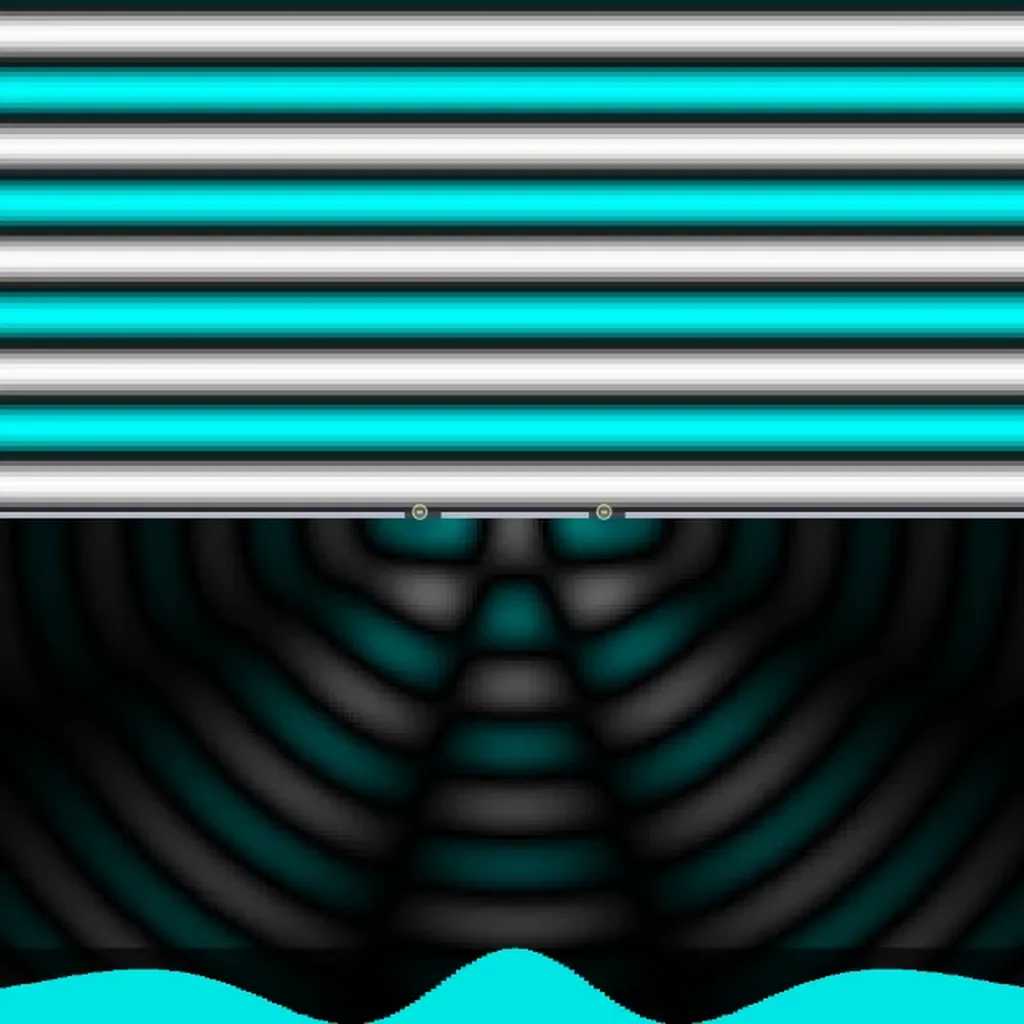
This simulation needs WebAssembly, and it could not start in this browser.
The image is a frame from a real run. Check that JavaScript is on, or try another browser.
Richard Feynman called two-slit interference “impossible, absolutely impossible, to explain in any classical way”. He meant particles. For a wave the effect is simple: a wave passes two openings, the two waves leaving them overlap, and they reinforce where crest meets crest and cancel where crest meets trough. The puzzle is that electrons, neutrons and even C60 molecules, sent through one at a time, build up the same fringes dot by dot.
Governing equation
The simulation treats every grid cell inside a slit as a point source, following Huygens’ principle, and adds up their circular waves, each falling off as as waves do in two dimensions. Far behind the barrier this sum approaches the Fraunhofer intensity
where is the slit width and the center-to-center separation. Bright fringes lie at , and the envelope is zero where with . Since , a fringe of order exists only if , and the envelope has zeros only if .
What you see
The upper half shows the incoming plane wave, the lower half the wave field behind the barrier, . Crests are white and troughs are tinted with a color that follows the wavelength, from violet for short to red for long. The strip along the bottom plots the intensity across the last row. Amplitude and phase are computed once whenever a parameter changes; each frame only advances the time.
Double slit (classic): , , cells. The first-order bright fringes lie at about 38° on either side, with dark fringes near 18° and 67°. The slits are narrower than the wavelength, so the envelope has no zeros and dims the outer fringes only slightly.
Single slit (diffraction): one slit of width 14. Since there are no diffraction minima: a single broad lobe whose intensity falls smoothly to about a fifth at grazing angles.
Narrow slits: slits 3 cells wide. Each acts almost like a point source, so the fringes sit where they do in the classic setting but are all nearly equally bright.
Close slits (wide separation needed): , less than . No first-order fringe can form; what remains is the central maximum with a dark fringe near 33° on each side.
Long wavelength: , , . The first-order fringes move out to about 53°, with dark fringes near 24°.
The region behind the barrier is less than three slit separations deep, so the picture approaches these far-field angles only roughly.
Parameters
double slit: switches between one and two slits.
λ wavelength (cells): the wavelength in grid cells, 8 to 50; it sets the scale of every feature.
slit width: the width of each opening, 2 to 20 cells; the envelope’s angular width scales as .
separation: the center-to-center distance between the slits, 10 to 80 cells; the fringe spacing scales as .