Game of Life
This simulation needs WebAssembly, and it could not start in this browser.
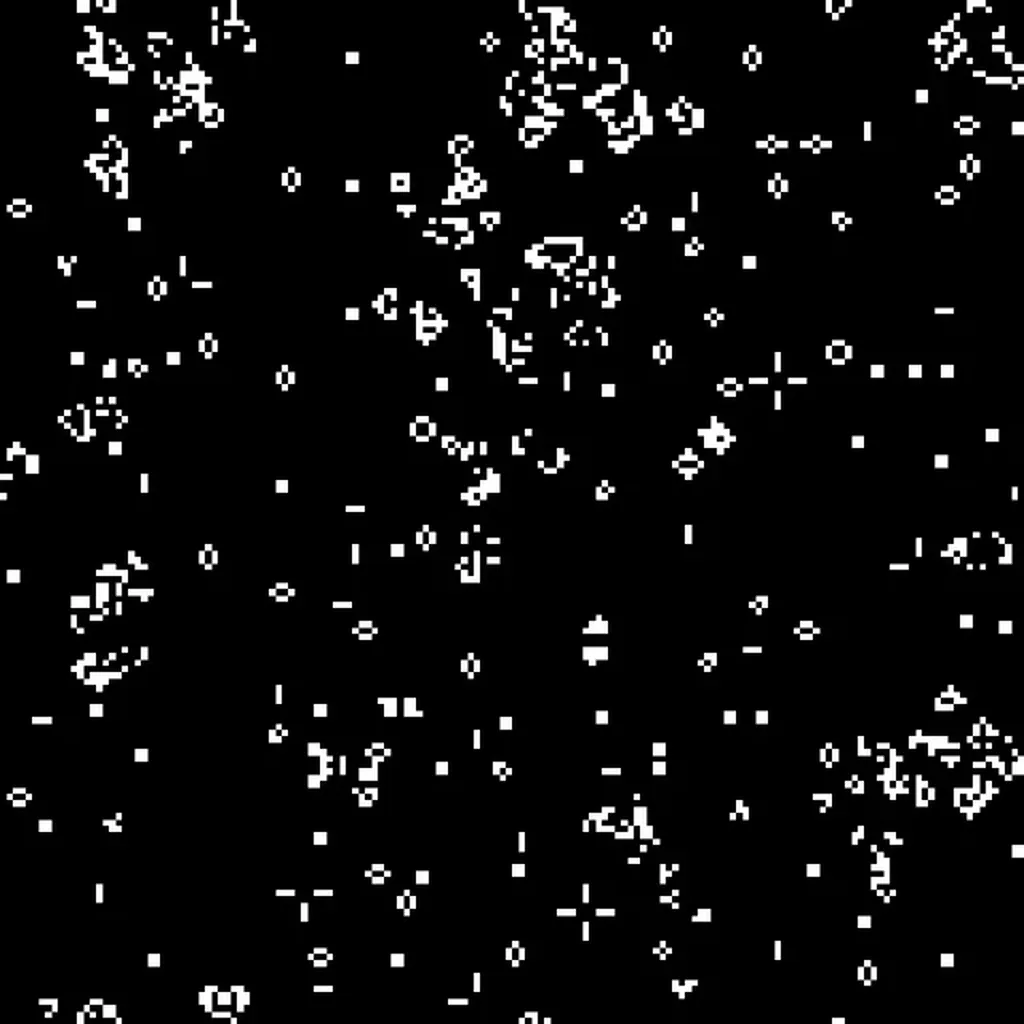
The image is a frame from a real run. Check that JavaScript is on, or try another browser.
John Horton Conway’s Game of Life, made public in 1970, is the best-known cellular automaton. Each cell of a square grid is alive or dead, and one rule updates all cells at once: a dead cell with exactly three live neighbors comes alive, a live cell with two or three survives, and every other cell is dead in the next generation. That is enough to produce still lifes, oscillators, gliding spaceships, glider guns and even self-replicating patterns. Life is also Turing-complete: in principle it can run any computer program.
What you see
Live cells are white, dead cells black, on a 160 by 160 grid whose edges wrap around, so the grid is a torus. Under the canvas, the page counts the live cells and the generations and shows the entropy of the grid.
random: about 30% of cells start alive (set by density). The noise quickly collapses into scattered still lifes and oscillators, with the occasional glider. The seed is fixed, so every reset gives the same start.
glider: five cells that return to their shape every 4 generations, shifted one cell diagonally, a speed of where is one cell per generation. Richard Guy found it in 1970.
glider gun: Bill Gosper’s glider gun from 1970, 36 cells that emit a new glider every 30 generations. It was the first known pattern that grows without bound.
acorn: seven cells that take 5206 generations to settle, on an infinite plane leaving 633 cells including 13 gliders.
R-pentomino: five cells that stay chaotic for 1103 generations before settling, on an infinite plane leaving 116 cells including 6 gliders.
pulsar: a symmetric oscillator of 48 cells with period 3, the most common one of that period.
On this finite torus the escaping gliders wrap around and eventually crash into whatever is left behind, so long runs here do not end exactly as they would on an infinite plane.
Parameters
Birth mask (B): a bitmask of the neighbor counts at which a dead cell comes alive. Bit stands for neighbors, so B3 is .
Survival mask (S): a bitmask of the neighbor counts at which a live cell survives. S23 is . Other values of the two masks give other Life-like rules.
density: the fraction of live cells at the start of the random preset.